Friday, October 8, 2010

Happened

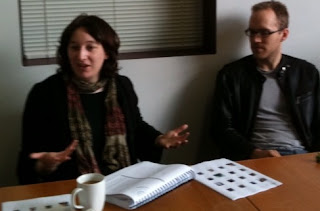
Happened. Indigenous Studies Teaching Colloquium. Over 40 registrations and at times 50 or so people present.  The aim was to have an open dialogue with a view to uncovering possibilities for cooperation, collaboration, and improvement. We commenced the day with four concise presentations by practitioners on key issues relating to Australian Indigenous studies and then broke off for discussion. What was evident was that there has been a rapid shift in what can be identified as Australian Indigenous studies at the University of Melbourne. Many of those in attendance were from schools and disciplines not previously associated with Australian Indigenous studies. It was energising to encounter exciting new initiatives being pursued in a spirit of openness and collegiality. Special thanks to the AIS team and Emma Kowal, Rebecca Garcia Lucas, and Alicia Coram.


Read. Leonard Peltier,  Prison Writings: My Life is my Sun Dance.  Leonard Peltier has spent years in prison for a crime many believe he didn’t commit: the shooting of two FBI agents in 1975 at Pine Ridge Reservation, South Dakota. Peltier’s description of the American prison system is brought into sharp relief by his commitment to Native American spirituality and his refusal of a degraded, inmate’s mentality. Chief Arvol Looking Horse, Keeper of the Sacred White Buffalo Calf Pipe writes the foreword to Prison Writings…


Seen. Yohanghza Theatre Company’s  Midsummer Nights Dream  and Hamlet. Essential Shakespeare presented through the prism of Korean shamanism and traditional culture. Inspiring – and left me increasingly dissatisfied with a lot of Australian and Australian Indigenous theatre. Maybe the theatre companies need less constraints and more corporate and public sector support.


http://www.theaustralian.com.au/news/arts/spirited-korean-take-on-denmarks-woes/story-e6frg8po-1225926373952


Melbourne Fringe.  AIS student Tom Carmody appears in Coma and the Good Times, The Open Stage, University of Melbourne. <http://www.melbournefringe.com.au/fringe-festival/show/coma-and-the-good-times/>.

Monday, September 13, 2010

Australian Indigenous Studies Practitioners' Colloquium

The Australian Indigenous Studies Program and the Indigenous Studies Teaching
and Learning Programs Sub-Committee are convening an annual colloquium for
 staff who teach and develop subjects with Australian indigenous content, or
 who teach Indigenous Australian students. The colloquium will focus on common 
issues, shared experiences and identification of best practice. It will 
conclude with a discussion of themes for a 2011 forum. Morning tea and lunch 
will be provided. Friday 17 September, 9:45am - 2:30pm, Yasuko Hiraoka Myer
Room, Sidney Myer Asia Centre. Enquiries: Johanna Simmons 8344 8143. RSVP
(essential) to: jsimmons@unimelb.edu.au

Sunday, August 29, 2010

The New Semester


Australian Indigenous Studies 100181. The start of a new semester and the good news is that we’ve held student numbers in our interdisciplinary foundation subject Australian Indigenous Studies. It will probably be the only chance many of these students have to do an Australian Indigenous studies subject, and one which introduces a breadth of perspectives and facts. It’s also the necessary foundation for developing an Indigenous studies program and I'll have more to say on this in future.


Dr Rachel Nordlinger, Linguistics and Languages, lecturing on Aboriginal languages for 100181 students.

Open Day, Sunday 15 August. As usual, louring weather as the AIS team backed up for an additional day’s work. Notwithstanding the weather this was a special Open Day for AIS. Each year an increasing number of the gifted and motivated make their way to our presentation. This year I was able to go through the suite of concordant subjects that make up the AIS major and honours program – an advance on the grab bag of subjects that sometimes follows from cross-listing, or discordant subjects sometimes quite loosely held together by the notion of ‘discipline’. It all made me think back to 2007 when we stepped up to back the Growing Esteem strategy. The spirit of optimism in the air then has been realised.


Tutor Coordinator Alicia Corum and tutor Tom Newman-Morris workshop ideas at a 100181 team meeting.


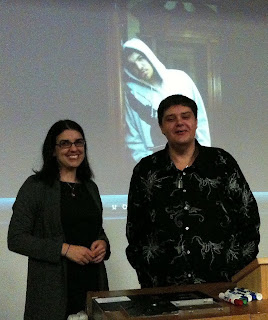
Odette Kelada, Australian Indigenous Studies and Jason Eades, Koorie Heritage Trust, lecturing for Critical Debates in Australian Indigenous Studies students.

Wednesday, July 14, 2010

NAIDOC Week

Honours. I’ve just received news that our Honours program has been approved. Thanks to Johanna Simmons, Sharon Tribe and Peter Eckersall, School of Culture and Communication, for support; and Marion Campbell, Associate Dean, Teaching and Learning, Faculty of Arts, for guidance. I’ve always envisaged a two-year window for setting up our courses. That’s been achieved.  


Worawa College, Healesville. Worawa College has experienced some upheaval in recent years but has re-established itself as an Indigenous all girls school.  It’s meeting an important need and we wish the school every success.

http://www.worawa.vic.edu.au/


Didn’t see  Jindalee Lady. Few people have seen this 1992 film though it is referred to in Marcia Langton’s Well I Heard it on the Radio… . Directed by the late Bryan Syron, it’s one of a corpus of hard to find films with Aboriginal actors made in the ‘80s and early ‘90s – an important transitional period in recent Aboriginal history. Unable to find a dvd of Jindalee Lady I subscribed to a company that listed the film for on-line viewing. After trying several computers and watching a blank screen I gave up.  Eventually I’d like a collection of these films in the University library.


Attended. Deborah Cheetham’s ‘Til the Black Lady Sings’ (Cheetham providing some insight into her life with reminiscence and song) and a preview (with cast) of ‘Pecan Summer’. The performance took place at BMW Edge and there was the magical combination of music, and outside, Melbourne’s lights reflected in the Yarra. Previously I’ve mentioned the Indigenous opera community Cheetham has created - noteworthy on the night were the numbers of grass roots Indigenous people in attendance and the powerful and immediate way they recognised the medium of opera as giving form to their histories and sentiments.


Visitors. Heather Dorries, an Indigenous Canadian scholar (Anishinaabe) arrives later this month to spend the semester with us.


A special perspective. Mr John Howells was a student in the subject Key Thinkers and Concepts last semester. No big deal except that Mr Howells is 78 years old and enrolled as part of the Community Access Program.   His thoughts on the subject:


BACK TO SCHOOL


People over fifty years of age like me (born 1932) learned little at school about Australia's indigenous people. How different it is now. Today nearly four hundred first year students at Melbourne University each year enrol in the subject, "Australian Indigenous Studies". Many go on to complete a major in the field and some go on to post-graduate study and research work. Every university across Australia has similar programs. School programs today also reflect this growing interest. One may expect that over the next ten or twenty years Australians will become well-informed about our indigenous people.


It is important that those of us, who are over fifty and who are concerned about the protection of human rights in Australia, seek to be well-informed about our indigenous citizens. With this in mind I took the second year subject, "Key Thinkers and Concepts", at Melbourne University during Semester 1 this year. There was a lecture each Tuesday morning from 9.00 till 10.30 and a tutorial from 11.00 till 12.00. Our lecturer, Philip Morrissey, a tall Aboriginal man, was excellent and introduced us to the anthropologists W.E.H.Stanner and Eric Michaels, the cultural studies theorist Stephen Muecke, the cultural nationalists Mudrooroo, Oodgeroo Noonuccal and Kevin Gilbert, the public servant and statesman Nugget Coombs, the reconciliation and social justice thinkers Mick and Patrick Dodson, the conservative thinker Noel Pearson, the Aboriginal educationalist Chris Sarra, and the Yolgnu leaders Mandawuy and Galarrwuy Yunupingu. It was fascinating and I enjoyed every moment of it. During the tutorials we took it in turn to introduce to our small group one of the set texts and to lead a discussion of it. We also had to write two essays on set topics during the course.


I was very nervous at first, but it was a great course and a great experience. The other students were all about nineteen or twenty years of age, but were very accepting of an old fellow like me. The first time the tutor called the roll and I answered "yes", one chap asked, "How long, John, since you last answered a roll-call?" When I replied, "about 60 years", there were grins all round. I was able to enrol through the University's Community Access Program which admits mature age students without prerequisites. How much did it cost? It is not cheap. As a former student I got a 20% discount, but it still came to $1,339.


I am now all fired up to share some of things I have learned and some of the books and other writings I have read. My first instalment follows. I hope you will be encouraged to read the book I am recommending.


John Howells


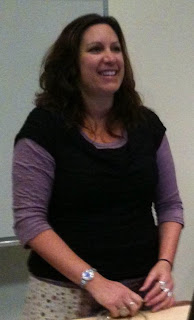
NAIDOC breakfast. A pleasant interval last Friday as Indigenous staff and students gathered with non-Indigenous colleagues for a NAIDOC Week breakfast. Simone Brotherton from the Centre for Indigenous Education orchestrated proceedings; Acting Provost Pip Pattison welcomed guests; Centre for Indigenous Education Manager Chris Heelan spoke on the history of NAIDOC; and Aunty Joy Murphy Wandin conducted the Welcome to Country in her own inimitable style that combines maximum dignity with personal warmth.


Tuesday, June 15, 2010

Stepping Up

Semester 1 2010 is now over. Once again thanks to our great tutors Naomi Tootell and Scott MacKay who really stepped up. The AIS team were challenged by things outside their control so the ride had its bumpy moments but there were a lot of highs. In delivering our new major the AIS team gave about thirty new lectures. Two of the lectures I gave, which still resonate, were on Dr H.E.C. ‘Nugget’ Coombs in our second year course Key Thinkers and Concepts and Deborah Cheetham and her forthcoming opera Pecan Summer, in another second year course Aboriginal Women and Coloniality. I always find it hard to square Coombs’ great achievements and evident wisdom with his impracticable, and sometimes irresponsible, ideas about Aboriginal development. In spite of my own reservations, Dr Coombs’ ideas carried the day with a fair number of the students. Pecan Summer is set to be a sensation when it opens later this year. As well as writing the opera Cheetham has created an Aboriginal opera community from scratch. These developments remind me of the Aboriginal and Torres Strait Islander dance community developed by Carole Johnson and others in Sydney in the 1980s which eventually led to the establishment of Bangarra Dance Theatre.

Grants. In the last fortnight we’ve submitted two grant applications – done while I’ve been in Europe. It would have been impossible without great support from Fran Edmonds (who has been coordinating applications) and Johanna Simmons.


Turku. I’ve just been at the International Society for Cultural History annual conference in, Turku, Finland. A great conference but occasionally standard history was presented as cultural history. ‘Micro-history’ seems to be the buzz word and will undoubtedly prove a useful rice bowl for historians. A couple of remarks from key note speaker Professor Jacques Revel that stuck in my mind:

‘Why should reasons [explanations] be simple?’

‘Why should we be simple when we can be complex?’


Read. Philip Roth’s The Human Stain 2000. A Jewish professor accused of racism is really an African American who, many years before, passed as white man. The novel suggests that his reasons for passing had more to do with the desire for freedom than opportunism though his sister observes that it was as logical for a light-skinned African American to pass in the1940s as it is to claim every drop of blackness in an age of affirmative action.


Watched. The Baader Meinhof Complex 2008, dr. Uli Edel. The best foreign language film I’ve seen in years. Tough and challenging, and a reminder that a few things were lost on the journey away from the Sixties.


Attended. I made use of 48 hours in London to attend a performance of Arthur Miller’s The Crucible and August Wilson’s Joe Turner's Come and Gone. I doubt that I’d see The Crucible performed at a comparable standard in Australia and Joe Turner’s Come and Gone requires an Afro-diasporic cast. The hieratic final scenes of The Crucible were as powerful as theatre ever gets. August Wilson’s play was written in the 1980s – so it’s of the same era as Jack Davis’ No Sugar. It left me wondering if we will ever see Aboriginal theatre re-emerging as a central Indigenous art form.

http://www.openairtheatre.com/pl113reviews.html

http://www.guardian.co.uk/stage/theatreblog/2010/jun/15/august-wilson-joe-turners-come-gone

Visited. Yinka Shonibare’s ‘Nelson’s Ship in a Bottle’ at Trafalgar Square. I was glad I took time out from my trip to the airport to check out this artwork. I’d expected it would be one more bleak work critiquing/deconstructing British imperialism. Instead its most salient qualities are lightness, freedom and optimism.

http://www.guardian.co.uk/artanddesign/2010/may/24/shonibare-fourth-plinth-ship-bottle

http://www.guardian.co.uk/artanddesign/2010/may/16/yinka-shonibare-fourth-plinth-trafalgar

http://www.london.gov.uk/fourthplinth/plinth/shonibare.jsp

Saturday, April 10, 2010

An Explanation and Three Films

A key staff member had to take unplanned leave just before semester started and we've struggled a bit delivering our new subjects. Productive work units get a lot of their dynamism from the positive emotional energy of staff. Even the most unhappy and dysfunctional workplace will have some rhetoric about team building. (Undoubtedly it's bound to be one of some team leader's key performance indicators.) So it's been hard - not just because there is more work for less people, but because we've lost a colleague and the inspiration they bring.

On a more upbeat note: it's been a good summer for films. The one I liked best was Rob Marshall's Nine but I saw three that have some relevance to Australian Indigenous Studies: Avatar, Bran Nue Dae, and Precious.


Avatar.
1. Major in its conception and execution.

2. The pseudo-problematic of the white ex-marine, Jake Sully, saving the Indigenous Na'vi is as boring as yesterday's newspapers. The Na'vi of course are cats and cats don't symbolise anything but cats. (One of the Na'vi warriors has part of his ear missing; presumably bitten off in a fight. Conclusive proof that they are cats.)


Bran Nue Dae.
1. It's been nice walking into mainstream cinemas and seeing Bran Nue Dae posters up alongside the standard Hollywood productions. One more sign of a small and productive shift in Settler Australia's perception of Indigenous Australia.

2. I enjoyed seeing some veteran performers again, as well as a new generation of Indigenous talent. I have however seen the original musical and it was impossible not to compare the film with the stage performance. The subtle wit of the musical has disappeared and the religious symbolism has been completely garbled. Catholicism and Evangelicalism are treated as though the differences are meaningless. In the musical the differences actually meant something. The closing scenes which are so powerful in the musical are oddly dissonant in the film - performers blithely singing about a 'magic night' in broad daylight.


Precious.
1. I was worried about this film. It's a favourite of Barbara Bush; and some African American critics have attacked, what they saw, as demeaning portrayals of black American men and black urban life. Surprisingly I found the film moving even though there is a lot to take against if you are inclined.

2. Notwithstanding her appalling life, sixteen year old Precious dreams of future happiness and gives this symbolic form in the fantasies she concocts from popular culture. Like many American films it's absurdly gauche but actress Gabourey Sidibe establishes Precious' subjectivity in the first frames of the film and then establishes an almost hypnotic narrative.

3. It's a classic tale of an outsider's desire for a community, and a place, not just where they can be happy but where they can be known, in all that miraculous singularity we're condemned to.


Friday, February 26, 2010

Anathemas and Universities

One of the most challenging aspects of contemporary Indigenous affairs is accounting for the diversity of perspectives held by Aboriginal leaders and intellectuals. The debate over the Northern Territory Intervention is probably the most salient example. Otherwise think of the differing political philosophies of Patrick and Mick Dodson, Noel Pearson or Warren Mundine. There is commonality but also important differences.

The challenge for Indigenous Studies is to develop coherent narratives that can frame this diversity and allow students to develop critical thinking skills with a view to forming philosophies cognate with their core values. The problem is that for some people Indigenous issues are the equivalent of moral issues, with right and wrong clearly defined. Those who are 'wrong' in this schemata are then anathematised - usually with the aid of some derogation. Any style of teaching Indigenous Studies, any Indigenous Studies subject, that offers 'right' answers will prove seductive even if the intellectual outcomes are verifiably limited. There is much more to be said on this; though I will note that the unsavoury aspect of this style of teaching can manifest as student on student bullying and name calling.